

Around mid-August in 2024, the buyer agent faced a new challenge in regard to compensation based on an NAR antitrust settlement where a jury had determined that a number of big box franchises had colluded to set commission rates. I had always wondered how closely related this determination was to Shaw’s, Stop & Shop, A & P and Friends getting together and setting milk at $10 per gallon rather than leveraging the market number, i.e. $8 per gallon, to paint oneself in a more favorable light but I digress.
More astonishing was the same jury concluding that the seller hadn’t the foggiest idea that he or she was compensating the buyer agent.
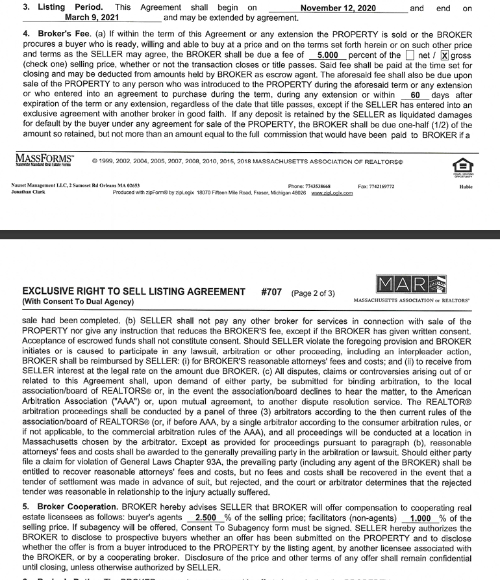
In the old days, 4. Broker’s Fee, as a byproduct of the listing agreement, would signal to the seller the percentage of the sale dedicated to the broker. In the very next section, 5. Broker Cooperation, a breakout of that total percentage, typically half, was illustrated as to what the buyer agent would realize from that total and from the listing agent. This buyer cooperation commission would be visible to any member of MLS when reviewing a listing.
Heading into the fall of 2024, the listing agreement doubled in length where a field was created identifying a percentage, if any, the seller would be aligned with absorbing as the result of a sale with a cooperating agency. This listing agreement, once the frontline essential document required, fully executed, was required in order to upload a listing. Today, submitting such a document is not only frowned upon but deflected as a hot potato as no third party entity wants to be in arm’s length of any commission dispute.
What happened out of the gate and to yours truly, is that sellers instinctively checked the no compensation box. In turn, a very awkward exchange when booking a listing appointment would arise when a sheepish buyer agent would ask, “Is your seller offering compensation?” Such as everyone else and brand new to the process, in addition to my living by the notion of never telling a lie so that you don’t have to remember a thing, I simply stated “no” as it related to my first listing in this brave new world. Having booked 6 showings in the first 24 hours of going live, a staggering 5 agents would circle back with scheduling conflicts of all shapes and sizes. In turn, real estate had reinvigorated a new strand of steering. Steering was the moniker given to the practice that was agents steering, directing buyers to and away from specific listings based on race, religion, sex and the like. In 2024, agents were steering buyers away from sellers that simply weren’t paying. Forty-five days later, the listing went under agreement where the buyer agent realized 2% and the seller could not have been happier.
So what happened? The new and improved offer document.

Rather than ask if the seller is offering compensation, the industry adapted quickly and supplanted that awkward moment with the less emotional offer doc where the agent or broker simply injects his or her perceived worth, which, however cumbersome and disjointed, brought the process back to where it began without advertising the matter as an enticement or encumbrance. Now treated as a contingency rather than standard procedure, the real estate world is slowly settling back on its original axis as informed listing agents and brokers are wise to condition their sellers with the eventuality of a buyer broker commission coming along with the offer. For the seller, this reality is, no different than it was under the original format, must be baked into the metrics before committing to a list price.
Regardless of the migration back to the principals of the former format now delivered through additional pages of listing and offer documents, this 2024 shift had an immediate impact on not only buyer agents and brokers but the buyers themselves. When faced with the misguided notion that the buyer would be on the hook for a buyer commission fee when presumably putting his or her best foot forward in the form of an offer, many chose to go it alone, unrepresented, and the uptick of deals sliding off the table and pendings reverting back to active status spiked begging the question, “Do I need a buyer agent?”
With a near 50/50 split between buyer and seller representations, I can attest that the listing side of the tracks carries the majority of water be it preparing the home for sale, showings, checking off the myriad of inspection requirements and the final cleanout to name but a few tasks, entails comparatively more time than accompanying buyers on tours, arriving at and submitting offers and attending the home inspection so the question is a bit subjective predicated entirely on the buyer’s level of comfort. As Massachusetts is in the national minority of states requiring legal scribes become a part of the process in pursuit of converting a fully executed offer into a larger version that is a purchase and sale agreement on the journey to acquire a quick claim deed, there is a built in layer of protection for the buyer in addition to a home inspection. Predating my brokerage, I would estimate that I have attended as many showings as a construction consultant/quasi home inspector, than I have shown homes as a traditional broker. In turn, humility aside, my very background in building, to say nothing of management, is entirely educated and relative intangibles that I bring to my buyers. This is not a segway into self-promotion rather one of many identifying attributes to look for not only in a buyer agent or broker but also a skillset you may feel deficient in.
No different than the seller side of the street, I take a very contrarian approach to real estate and while I pencil in a buyer broker fee to each offer, mine does not impact the sale. I’ve received offers on behalf of sellers where the buyer agent fee is larger than mine which never lands well with sellers and in such case, where the buyer agent does not treat and adjust his or her commission as a contingency, I’ve been provided with the required documentation when an agent agrees to a reduced commission from the seller while collecting the balance from the buyer and still other cases where the buyer agent somehow or another compels the buyer to increase the purchase price in order to zero out the margin.
When determining whether or not you need a buyer agent, consult a handful in order to gain a better understanding of not only the process but also the expectations on the compensation front. While recommending securing the services of a buyer agent may seem self-serving, it does create a smoother track but again, understand what, if any, compensation you may be inclined to pay so that you might measure give against the take.
I routinely tell my perspective buyers that beyond the value I lend given my relative background, when most bid farewell at closing, we’re just getting started whether it is implementing a management program or addressing perceived wants and needs facilitated through my vast network of resources but for my part, I simply do not impose fees on buyers to say nothing of circling back to collect shortcomings regarding a requested commission through an offer.
Poaching and expanding on a generic list of items buyer agent pros trumpeted on a big box website include…
1. It usually won’t cost you a dime.
Item one was just covered. I don’t impose fees on buyers but while mulling your options, this should be a top line question so that you might quantify the offering in return.
2. Having a finger on the pulse of the market.
The premise here is that the agent understands market trends, the likelihood of competitive offers and how to navigate those waters and forecasting the rise and fall of values and inventory. As nearly half of the housing stock in the lower and outer Cape markets are secondary, most buyers are invested in a long play unforeseen events aside making the educated forecast of value and inventory not only speculative, but a seller is not concerned with those variables when reviewing an offer. In terms of a competitive environment, how one reacts to that is vastly more important than signaling the potential.
3. Coordinate showings.
A phone call.
4. Research the neighborhood.
There is certainly value here. Not only a neighborhood but rather a working knowledge town-by-town. Every Cape town has beaches, ice cream and best chowder award but beneath the surface, subtle shifts in vibe and personality have the makings of turning home into a lifestyle.
5. Researching the house itself.
Again, there is value to be had here and when vetting a buyer agent, particularly one with a fee, understand the depth of analysis you might expect. From a builder’s perspective, I have spared many the trip to the Cape and subsequent disappointment by previewing and/or conducting Facetime showings and leveraging my building background that ultimately determines whether or not a live showing is warranted.
6. Advise you on what to offer.
I’ve watched buyer agents thoroughly break down and justify deficiencies in a home while still others hope such deficiencies don’t scuttle a deal. For my part, I’ve spent upwards of two years landing a home for buyers based entirely on cultivating quotes for perceived and desired improvements and leveraging those metrics against a budget cap and as I tell each buyer, it’s a process not a grind and I would much prefer spending two years getting my buyer into a home they over verses two weeks jamming them into a house they like.
7. Advise you on financing and find you a lender.
For my part, I am not a financial advisers but right along side my plumbers, electricians, koi pond installers, insurance brokers and attorneys, I have two area lenders that I highly recommend based purely on transparency and efficiency.
8. They will be your professional negotiator.
A bit of filler as this is a rehashing of item 6.
9. Navigating emotional territory is part of the job.
While there are moments of disappointment during the buying process, in my experience, emotion resides almost exclusively on the seller side of the tracks. Regardless, with an unflappable loyalty to the notion of never pushing, pulling or badgering, I understand the process and a steady unbiased hand should be baked in expectation rather than a line item supporting compensation.
10. Your agent has extensive experience looking at houses.
Makes one wonder how agents get started. While repetition should turn diligence into muscle memory, I would submit that close to three decades of building experience, coupled with managing upwards of 200 seasonal homes before speaking to real estate specific extensive experience looking at houses, I am comfortable checking this box as I’ve always subscribed the enhanced value that comes with understanding how a home is built rather than simply staged.
11. They understand how to navigate real estate contracts.
Not nearly as daunting as they are presented to be, there are in fact several boilerplate documents required to fulfill the process but if this is one of your few apprehensions that has you on the fence in regard to hiring a buyer agent, I would simply suggest having your attorney review any documentation you not be comfortable with as he or she will eventually become part of the process regardless.
12. They have connections to get you through the buying process.
Such as finding you a lender, item 12 is a bit off filler. In addition to the lender, you will need a home inspector should you option a home inspection, and an attorney. By extension, having a specific subcontractor in arm’s reach should a finding become a negotiation matter where a professional assessment and quote are essential, trusted resources are most helpful.
13. Your agent will ensure the transaction remains on schedule.
Once your offer has been accepted, there is very little your agent or broker can do to ensure the transaction remains on schedule. At this point in the process, we’re navigating the inspection process and any findings as a result may be negotiated but for all intents and purposes, the fully executed offer is now in the hands of attorneys who, if chosen correctly, should produce a wider version of the fully executed offer in the form of a purchase and sale agreement. At the same time these third parties are working on that which is outside of our control, we’re assuming your lender is going to stay on track who is also at the mercy of a timely appraisal. On the seller side of the tracks, we’ll be waiting on that camp to produce a “passed” septic inspection, fire inspection, final water meter read and/or well water analysis and have the home broom clean prior to closing.
Understand the financial obligation and weigh that number, if any, against the value propositions presented in the consultation. From there, you may then determine whether or not going it alone and leaning on a home inspector, lending institution and real estate attorney creates a comfortable path or if looping a vetted and qualified buyer agent into the process is more advantageous approach.
